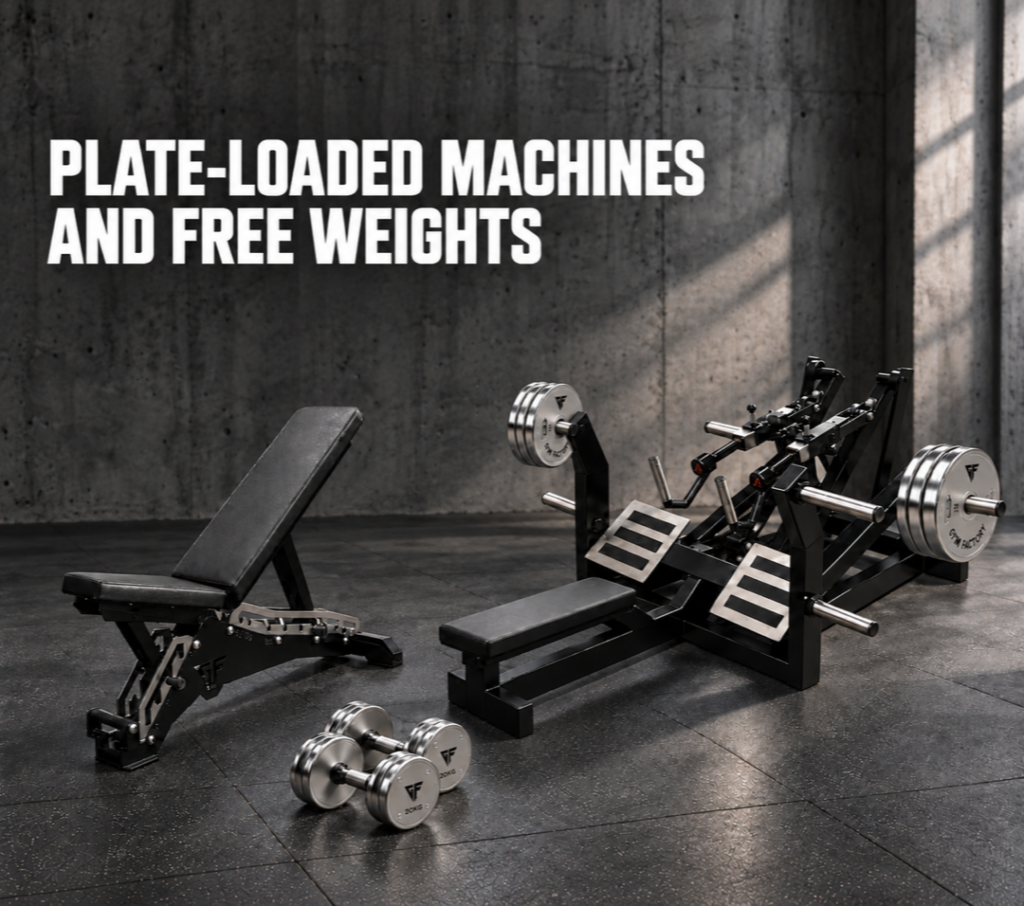
Both machines and free weights can help you build muscle and increase strength. When choosing between them, consider the movement you want to train, whether the equipment lets you perform the exercise comfortably, and how you will increase the load. A label on a machine or a heavy dumbbell alone does not guarantee better results.
A systematic review and meta-analysis published in 2023, covering 13 studies, found no statistically significant difference in muscle growth between training with free weights and machines. Strength outcomes were related to the testing method: practising a particular movement helped participants perform better in a similar strength test. This does not prove that every programme or every machine will produce the same result. [1]
The American College of Sports Medicine (ACSM) updated its recommendations for healthy adults in 2026, emphasising regular participation and training all major muscle groups at least two days per week. Equipment type alone is not consistently identified as a decisive factor in the results. [2]
A practical choice starts with your goal. If you want to improve a specific barbell exercise, allow time to practise that movement. If muscle growth is your priority, choose exercises whose execution and progression you can track consistently.
Free weights include dumbbells, barbells and other weights whose movement is not constrained by a machine mechanism. When performing an exercise, you control their position and movement yourself. The same set of dumbbells can be used for different exercises, but each requires you to learn the appropriate starting position and technique.
The movement path of many lever-based strength machines is determined by their construction. Before training, you need to adjust the seat, supports or starting position to suit you. Cable machines can offer more freedom of movement, so machines should not all be treated as the same.
It is also useful to distinguish between terms used in equipment catalogues. “Free-weight machines” often refers to plate-loaded lever machines. Although weight plates provide the load, the mechanism still guides the movement. This is different from an exercise with a freely moving barbell.
| Selection criterion | Machines | Free weights |
|---|---|---|
| Movement control | Depends on the design; a lever often guides the movement. | You control the movement of the weights yourself. |
| Preparation | Adjust the seat, supports and load. | Select the weights, bench or rack, and starting position. |
| Changing the load | Use the weight-stack pin or change the weight plates. | Change the dumbbells or barbell plates. |
| Space planning | Allow for each machine's operating area. | Allow for exercise space, racks and weight storage. |
As a Lithuanian gym equipment manufacturer, we devote considerable time to biomechanics: how people move and how the machine's load acts on them. Plate-loaded models make up the majority of the machines we manufacture.
On these lever-based machines, the weight of the plates is not the only factor that matters. As the lever changes position, the resistance it creates can also change: the exercise may feel harder in one part of the movement and easier in another. The geometry of the levers, the position of the rotation axis and the location of the weights all affect the loading characteristics. [3]
This is one reason we pay close attention to construction. During design, we aim to match the movement path and changes in resistance to the purpose of each exercise. Depending on the model, the construction can create greater resistance in a selected part of the movement and reduce it in another. We plan this distribution of resistance when designing the machine.
Start by choosing the movement you want to train. For example, you can perform a chest press on a lever machine or with dumbbells on a bench. When trying the options, consider whether the starting position is comfortable, whether you can reach the handles and whether you can control the entire chosen movement.
Next, check the available load increments. If the smallest possible weight increase is too large for you, planning steady progress will be more difficult. It helps to know not only the maximum load but also the minimum working resistance and the available steps in between.
Beginners should spend time learning equipment settings and exercise technique. A machine with supports can be a convenient starting point, but it still requires familiarisation. More experienced users can choose according to the specific task, rather than assuming that one category of equipment is always only for beginners.
Record the exercise, equipment settings, weight and repetitions in your training log. When changing machines or moving from a machine to dumbbells, do not compare the kilograms directly: the mechanisms and movement conditions differ. Assess progress by comparing the same exercise under similar conditions.
Start with the purpose of the workout. If you want to learn the barbell squat, give that exercise a specific place in your programme. You can choose another leg exercise on a machine, taking your overall weekly workload and capabilities into account. If your goal is to strengthen your back, your programme might include both a dumbbell row and a cable row.
These are examples of exercise choices, not a requirement to use both equipment categories in every workout. Before adding an exercise, identify what it is meant to achieve. Using several similar chest-press machines in succession is not, by itself, a sign of a well-designed programme.
A clear plan supports consistency: selected exercises, familiar equipment settings and recorded results. Increase the load while maintaining controlled execution. If an exercise causes pain, stop and consult a qualified professional.
Gym equipment should suit your members' needs and the available premises. Before ordering a large number of machines, plan where free-weight training will take place, where the machines will stand and how people will move between these areas.
Review the catalogue according to the movements you want to offer and the expected number of users. This makes it easier to spot whether several machines serve very similar functions while another area lacks a simple bench or suitable weights.
Yes. The research review does not show that free weights are essential for muscle growth. [1] However, your programme should cover the movements you need and be followed consistently.
There is no universal choice. First consider whether you understand the exercise, whether the equipment is adjusted correctly and whether you can select a manageable load.
Start with your planned exercises, available space and budget. Dumbbells and an adjustable bench can provide a foundation for a variety of exercises. Add a specific machine when you know which function is missing.
At Gym Factory, we manufacture strength-training machines in Lithuania. When planning a commercial gym or personal training space, explore our cable machines, plate-loaded lever machines, workout benches, and weights and barbells. Consider the purpose of each category alongside your training plan.
If you are planning to equip or expand a gym, contact Gym Factory with details of the floor area, expected users and the intended purpose of the equipment. This information will help us discuss suitable options for your space.
Newsletter
Subscribe to our newsletter for the latest news, discounts and special offers from Gym Factory.


